Scoliosis is a sideways curve of the spine that most often appears during the growth spurts of childhood and adolescence. When a curve is found early, families have more time to understand it, monitor it, and explore conservative options like the Schroth method — before larger curves are the only thing left to manage. This article explains what parents in KL can look for at home, how scoliosis is actually measured, and what a screening visit at One Spine TTDI involves.
What is scoliosis?
Scoliosis means the spine curves sideways, usually forming an "S" or "C" shape instead of a straight line when viewed from behind. Doctors describe the size of the curve using the Cobb angle: a curve of 10 degrees or more is generally considered scoliosis. Most childhood curves are small, but during rapid growth they can sometimes progress, which is why monitoring matters.
Why early screening matters
The fastest curve progression usually happens during the growth spurt — commonly between ages 10 and 15. When a curve is detected early:
- The family knows what to watch, instead of discovering a larger curve later by chance
- Conservative, movement-based approaches such as Schroth exercises can be introduced while the curve is still small
- If medical treatment is needed, there is more time for the orthopaedic specialist to plan it
Early screening does not mean rushing into treatment. It means getting a baseline measurement and a clear plan.
Signs parents can notice at home
No single sign confirms scoliosis, but these are worth checking occasionally, especially during growth years:
- One shoulder sitting higher than the other
- One shoulder blade sticking out more than the other
- Uneven waist or hip, with one side higher
- Clothes (shirt hems, skirts) hanging unevenly
- The child leaning to one side when standing naturally
These signs can also come from simple postural habits, so they point to "worth checking" rather than "definitely scoliosis".
How scoliosis is measured
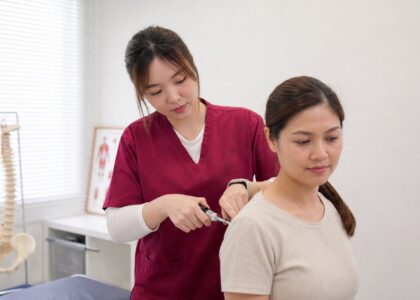
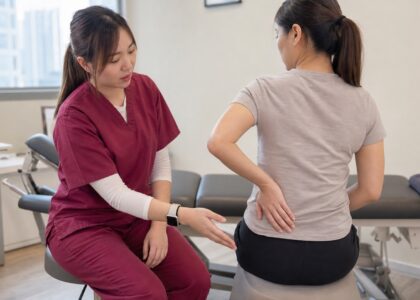
The standard medical measurement is the Cobb angle, taken from an X-ray. Before any imaging, a screening usually includes a posture and movement check, sometimes with surface measurement tools that estimate the shape of the spine without radiation. At One Spine TTDI, our screening visit includes a posture and movement assessment — and we refer for X-ray and orthopaedic review when that is clinically appropriate, rather than measuring curves ourselves beyond what surface assessment can show.
What happens after a screening visit
A screening gives a starting point. Depending on what is found, the next step may be:
- Monitoring: small curves are often followed over time, with repeat checks through growth
- Schroth method: a specialised exercise approach designed for scoliosis, taught by practitioners trained in it — Ivy Ting at One Spine TTDI is a Certified Schroth Best Practice practitioner
- Orthopaedic referral: for larger or progressing curves, the orthopaedic surgeon decides whether bracing or surgery is appropriate. We do not offer bracing or surgery, and we refer rather than overstep that boundary.
When should parents consider a screening?
Screening is most useful during the growth spurt, and a single check at around 10–12 years old is a reasonable starting point for many families — earlier if you notice uneven shoulders, hips, or posture that looks asymmetrical. It is also reasonable simply because you want a baseline. A screening visit is not a treatment commitment; it is information. For families already exploring options, our scoliosis treatment in KL page explains the assessment-first approach.
FAQs
At what age should a child be screened for scoliosis?
The growth spurt between about 10 and 15 is when curves most often appear or progress. A first check around 10–12 is common, and earlier if you notice asymmetry.
Does chiropractic treatment straighten scoliosis?
We are honest about this: scoliosis curves are structural. Care such as the Schroth method focuses on posture, movement and muscle support around the curve, and larger curves are managed by orthopaedic specialists. We assess and refer rather than promise straightening.
Is the screening covered in the first visit?
The first visit at One Spine TTDI includes consultation, assessment and explanation at RM238, which includes a 3D AI posture scan.
Do you see children at One Spine TTDI?
Yes, we assess children and teenagers, including for scoliosis screening and Schroth-based exercise guidance, with referral to orthopaedic care when needed.